How Do You Release Tight Hips? (Hint: Stretching Alone Won't Fix It)
If you've been stretching your hips for months — or years — with little to no relief, you're not alone. Tight hips are one of the most common complaints I hear from women over 40, and here's what's frustrating: stretching alone often doesn't fix the problem.
After more than a decade as a certified Pilates instructor, I've worked with hundreds of women who've tried every hip flexor stretch in the book. They do the pigeon pose, the figure-four, the lunge stretch — and still wake up stiff, still feel that familiar pull, still can't move freely.
So what's actually going on? And more importantly, what actually works?
Why Stretching Isn't Enough
Here's something that might surprise you: tightness and weakness often go hand in hand. Where there is weakness, there is often tightness. The body is incredibly smart — when a muscle group is weak or underused, the surrounding muscles tighten up as a form of protection.
This means that if you're only stretching your hips and not strengthening them, you may actually be working against your body. You're trying to lengthen muscles that are gripping on purpose — because they don't feel stable enough to let go.
The real solution? A combination of targeted strengthening and mobility work.
Motion Is Lotion: Why Movement Heals
I love the saying "motion is lotion" — because it's genuinely true when it comes to hip health. Movement is medicine for your joints, and here's the science behind it: when you move your hips through their range of motion, you stimulate the production of synovial fluid.
Synovial fluid is your body's natural joint lubricant. It coats the cartilage, reduces friction, and delivers nutrients to the joint tissue. When we're sedentary — sitting for long stretches, not moving mindfully — the hips don't get that lubrication. They stiffen up. Things start to ache.
Consistent, gentle movement is one of the most healing things you can do for your hips. Not high-impact. Not aggressive stretching. Intentional, regular movement that takes your joints through their range.
The Right Approach: Strength + Mobility Together
In my online Pilates studio, I teach my members that releasing tight hips isn't about one magic stretch — it's about building a foundation of both strength and mobility. Here's what that looks like in practice:
Strengthening the hips and glutes so the surrounding muscles feel secure enough to release their grip. Think movements like clamshells, side-lying leg lifts, and hip bridges.
Mobilizing the hip joint through gentle, controlled movement that encourages synovial fluid production and opens up the full range of motion — not just a passive held stretch.
Moving consistently — not occasionally. Two times per week is a realistic, sustainable starting point. You won't feel results overnight, but with regular practice, your hips will start to respond.
A Note on "Less Is More"
This is something I say often to my members, and I'll say it here too: always move within a range of motion that feels comfortable for you. Especially if your hips have been tight for a long time, pushing into pain or discomfort isn't going to speed things up — it's more likely to cause you to tense up or back off entirely.
Less can be more. Small, consistent movements done with body awareness will get you further than aggressive stretching sessions that leave you sore. Listen to your body, and let the work build gradually.
I've put together a short YouTube video specifically designed to help you reset your tight hips using this exact approach — a blend of gentle strengthening and mobility that you can do right now. It's beginner-friendly and requires no equipment.
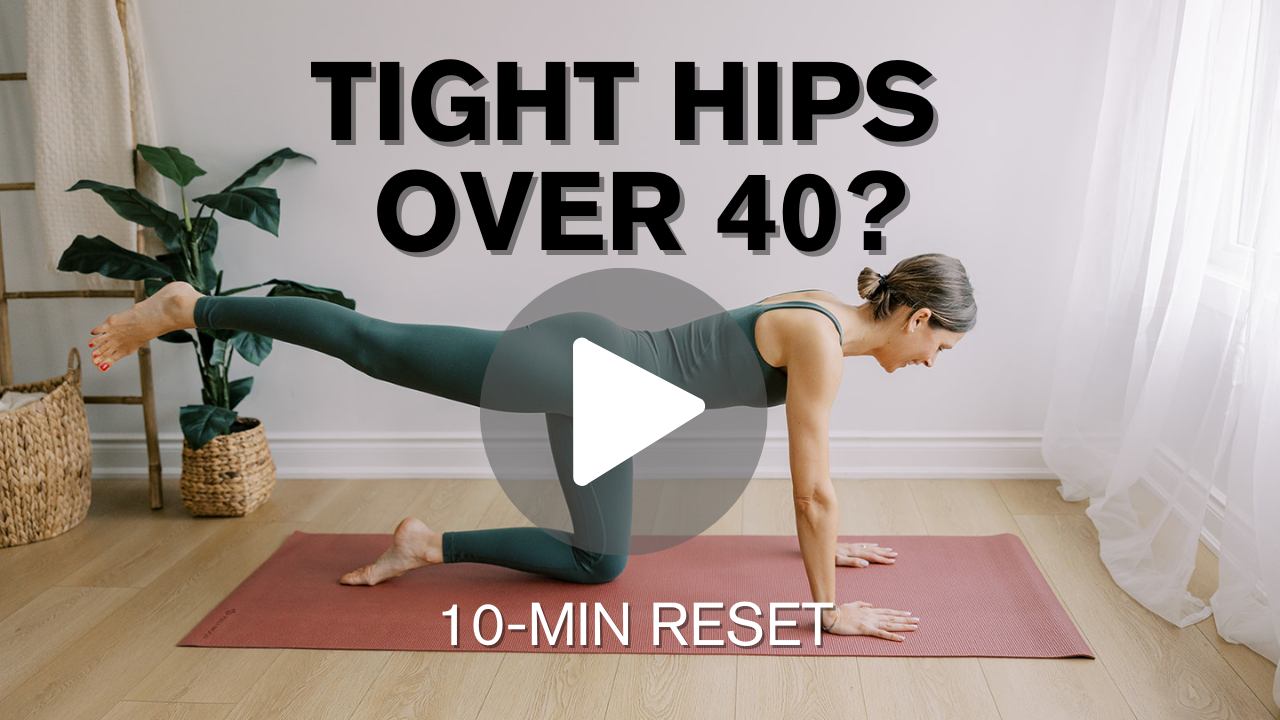
Don't expect overnight results — but commit to doing this 2x per week and you will start to notice your hips loosening up. It takes consistency, not intensity.
The Bottom Line
Tight hips are incredibly common, especially as we get older and spend more time sitting. But they're not something you just have to live with. The key is understanding that stretching alone isn't the answer — your hips need to be strengthened and mobilized together, regularly and gently.
Motion is lotion. Movement is medicine. And when you give your body the right kind of movement — consistently — it will respond.
–
Christine Kirkland is the founder an online Pilates studio designed specifically for women over 40. After teaching Pilates for over a decade and working with hundreds of women through perimenopause and beyond, she created a method focused on pain-free movement, proper alignment, and sustainable strength building. Learn more at my-pilates.ca