Pilates After 40: The Ultimate Guide to Muscle Retention, Mobility, and Longevity
By Christine — certified Pilates instructor, founder of Christine Kirkland Pilates
If you've landed here, chances are your body has started sending you messages it never used to. You wake up stiffer than you remember. A workout that once left you energized now leaves you wrung out for two days. The scale creeps even though nothing about your eating has changed. And somewhere along the way, a quiet voice started whispering that this is just what getting older feels like — that the best years of your body are behind you.
I want to gently push back on that. After more than a decade of teaching women through their 40s, 50s, 60s and well beyond — many of them starting movement for the very first time — I can tell you with confidence that your body isn't declining or breaking down. It's pivoting. What you're feeling is a real, physiological shift in your hormones, your muscle, and your connective tissue. It is not a life sentence, and it is not a signal to work harder.
In fact, working harder is often exactly the wrong instinct after 40. The women who thrive in midlife aren't the ones grinding through punishing bootcamps. They're the ones who learn to work smarter — to realign the body before they load it, to build strength on a foundation that can actually hold it. That's the whole premise of this guide, and it's the philosophy I've built my studio around: undo first, then build.
This is your complete resource for understanding what's changing in your body and why Pilates is uniquely suited to meet it. We'll cover the science of the midlife shift, exactly why controlled, intelligent movement outperforms high-intensity effort right now, how to design a sustainable weekly practice, and answers to the questions I hear most often. Let's begin.
The Midlife Pivot: What Actually Changes in Your Body After 40
The frustration so many women feel in midlife comes from using the same tools that worked at 30 and getting worse results. That's not a failure of willpower. It's that the body you're training has genuinely changed underneath you. Three physiological shifts matter most, and understanding them changes everything about how you should move.
Fluctuating Estrogen and Perimenopause Joint Pain
Estrogen does far more than regulate your reproductive cycle. It is quietly, deeply involved in the systemic health of your joints, your collagen production, and the flexible connective tissues that hold you together. Estrogen helps maintain the baseline lubrication and structural elasticity of your cartilage, tendons, and ligaments.
As estrogen levels begin to fluctuate and fall during perimenopause and menopause, many women suddenly notice deep aches, joint pain, and structural tightness they’ve never had before. That morning stiffness, the creaky first steps out of bed, and the hips or shoulders that feel less willing than they used to are incredibly common experiences. Clinicians refer to this onset of aches as menopausal arthralgia.
Here's the part I most want you to hear, because I say it to my students constantly: it's not just age — it's stillness. Falling estrogen sets the stage, but the tightness deepens dramatically when we respond to it by moving less. Stiff joints make us cautious, caution makes us sedentary, and a sedentary body stiffens further. It's a continuous downward loop.
The good news is that it's a loop you can interrupt, and gentle, full-range movement is precisely how you do it. Your joints are designed to be lubricated by motion. Give them intelligent motion, and much of that "aging" stiffness begins to lift.
Sarcopenia: The Age-Related Muscle Loss Nobody Warned You About
This is the single most important word in this entire guide: sarcopenia is the age-related loss of muscle mass and lean muscle strength. Starting around age 30, we naturally begin losing muscle — roughly three to eight percent per decade — and that rate accelerates rapidly as we move through our 50s, 60s, and beyond. Unless you're deliberately giving your muscles a clear reason to stay, they quietly leave.
This issue isn't just about looking toned. Muscle is highly metabolically active tissue. Sarcopenia is a major reason why your baseline metabolism slows in midlife—you are simply carrying less of the metabolic engine that burns everyday energy. Furthermore, lean muscle protects your joints, stabilizes your shifting spine, and keeps you strong enough to carry groceries, lift grandchildren, and catch yourself when you stumble. Losing it is closely tied to the loss of physical independence we most fear later in life.
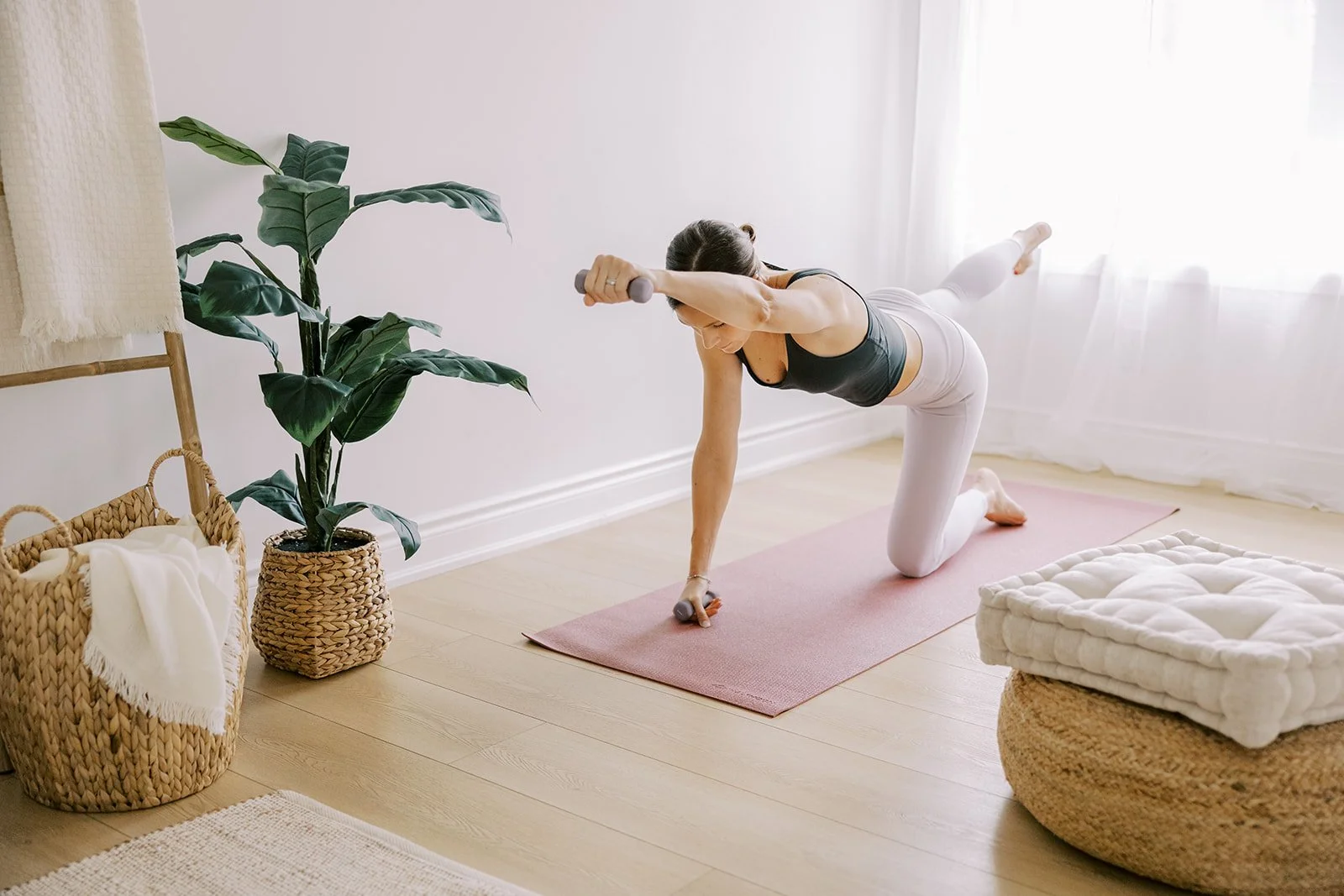
The word "deliberately" is the absolute key here. Muscle tissue only responds to being asked to work consistently against active resistance. While classic mat work challenges the body through gravity, you don't necessarily have to lift heavy dumbbells to make that demand.
In my online Pilates studio, we counter midlife muscle loss by incorporating targeted, low-impact props into traditional sequences. Adding structured resistance through a Pilates Magic Circle, elastic resistance bands, or light weights gives your muscles the repeated stimulus required to trigger muscle hypertrophy safely, without demanding joint strain.
This is why simply "staying active" with daily walking, while wonderful for your heart, isn't enough on its own to hold onto structural muscle. Your body needs a specific, repeated resistance stimulus, and that's something a smart Pilates practice delivers beautifully.
The Cortisol Trap: Why High-Intensity Workouts Backfire in Midlife
There's a cruel irony in midlife fitness. Right when women feel the immense social pressure to "do more" to fight their changing bodies, the body becomes significantly less tolerant of relentless high intensity.
A hard, punishing workout dramatically spikes cortisol, your primary stress hormone. That's completely normal and even healthy in the short term for a young body. The problem in midlife is metabolic recovery. As your overall hormones shift, the female body becomes highly sensitive to being under-recovered.
When you stack exhausting, high-intensity bootcamp sessions on top of poor perimenopausal sleep, career stress, and everything else you're carrying, your cortisol levels can stay chronically elevated rather than settling back down. Chronically high cortisol is directly associated with stubborn abdominal fat retention, systemic inflammation, severe sleep disruption, and a bone-deep fatigue that no amount of pushing seems to fix.
So, the woman who responds to midlife weight gain by throwing herself into daily high-intensity cardio often finds herself more exhausted, more inflamed, and no lighter. She's fighting her shifting physiology instead of working with it. The answer isn't to stop challenging your body—it absolutely needs to be challenged. The answer is to challenge it in a way that builds you up without tipping you into constant nervous system stress. That's the sweet spot, and it's exactly where Pilates lives.
Why Pilates Is Uniquely Aligned With a Changing Body
Once you understand the three shifts above, the case for Pilates almost makes itself. It directly answers every one of them — building muscle without joint punishment, restoring mobility, protecting bone, and challenging the body without flooding it with stress. But I want to go deeper than the usual list, because how Pilates does this is the whole reason it works when other things haven't.
Building Lean Muscle Without Punishing Your Joints
The genius of Pilates is that it creates real muscular demand through control rather than impact. When you move slowly and precisely against your own body weight or resistance props, your muscles are under sustained eccentric and concentric tension. Sustained tension is a powerful signal for your nervous system to keep and build muscle tissue.
Because there's no jarring, no jumping, and no sudden loading of a vulnerable joint, you get the muscle-building benefit without the structural wear and tear. This matters enormously for the exact joints that get cranky after 40. Knees, hips and the lower back — the places where high-impact exercise so often causes painful flare-ups — are protected in a well-designed Pilates session. You're not slamming through speed repetitions; you're controlling every single inch of the movement.
I've watched countless women who had written off strength training entirely because of sore knees discover they can absolutely rebuild strength—they just needed a method that didn't ask their joints to absorb high-impact forces they can't tolerate right now.
This is also where my core teaching philosophy comes in: undo first, then build. Most fitness programs try to build strength directly on top of whatever alignment a person happens to have. If that alignment is off—if years of desk-sitting and compensation patterns have left them out of balance—loading strength on top only cements the dysfunction. It's building a second story on top of a crooked foundation. My approach is to release the tightness and correct the postural compensations first, and only then add strength. Pilates is one of the few methods that lets you realign and strengthen in a single, integrated flow.
Deep Core Stabilization and Pelvic Floor Health
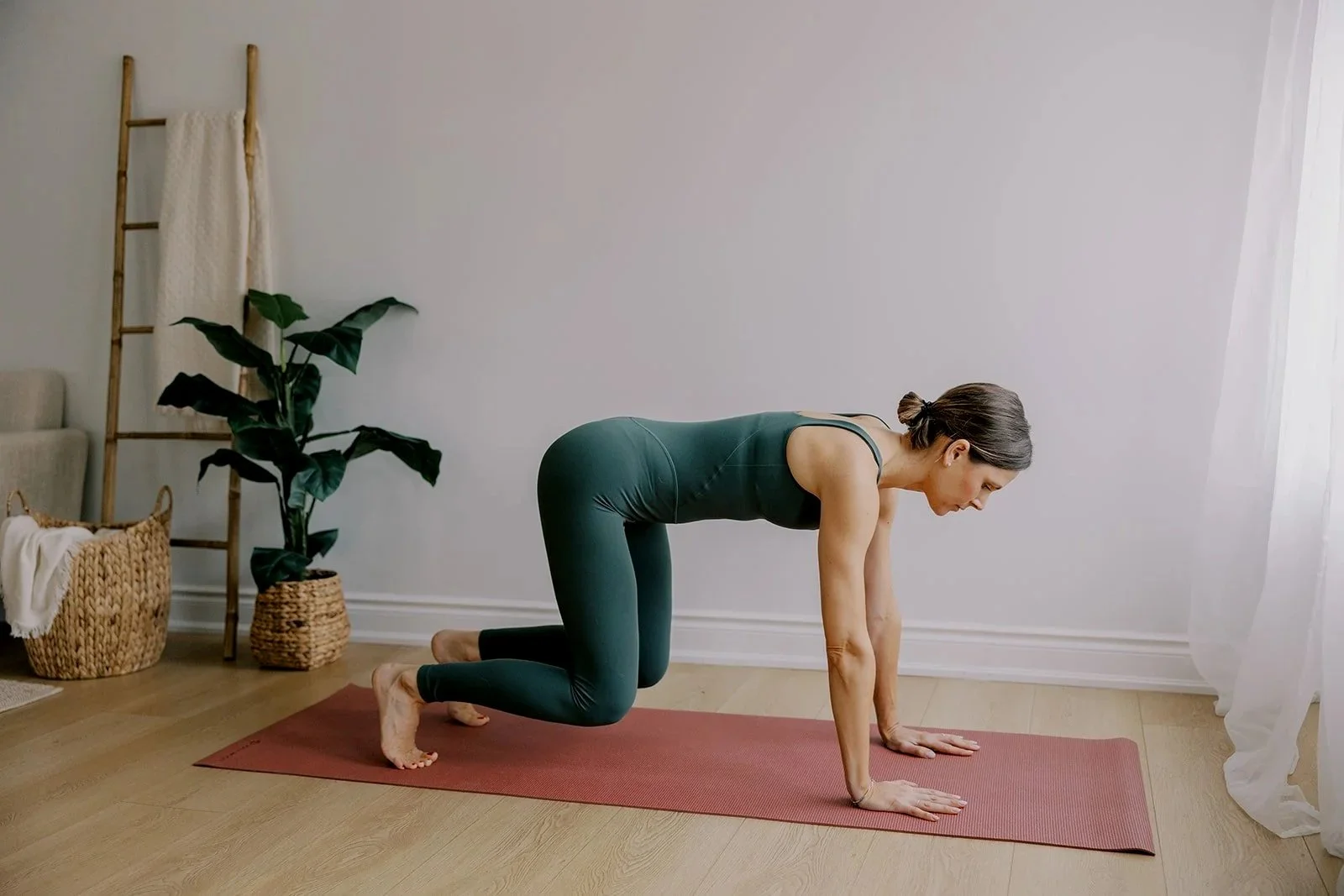
When most people hear "core," they think of six-pack abs. The core I care about — and the one that matters most as we age — runs much deeper. I define it broadly for my students: everything from your shoulders to your hips, the whole cylinder of muscle that stabilizes your trunk. This includes the deep transverse abdominis that wraps around you like an internal supportive corset, and the pelvic floor beneath.
Training this deep core does things that change your daily life:
Offloads the Lumbar Spine: Deep abdominal activation takes the direct physical pressure off your vertebrae, which is why so many women find their nagging lower-back discomfort eases within weeks of starting.
Improves Posture: It actively counters the forward neck hunch and rolled shoulders that creep in over years of desk work.
Supports the Pelvic Floor: It directly addresses a genuine quality-of-life issue for many women in midlife that too few of us talk about openly.
Improves Functional Balance: A stable, reliable center is what your body organizes every single physical movement around.
That balance benefit deserves its own spotlight, because balance is not a vanity metric. The ability to catch yourself, to stay steady on uneven ground, and to feel confident on your feet is one of the single greatest predictors of staying independent and active in your later decades. Every time we train stability in a Pilates class, we're making a deposit in that longevity account.
Here is a principle I come back to again and again with my students: stability creates mobility. When your center is strong and steady, your limbs are free to move fully, dynamically, and confidently. The two aren't opposites — one unlocks the other.
Protecting Your Bones the Smart Way
I run an entire program around this because it's so often misunderstood. As estrogen falls, bone loss accelerates—the years around menopause are a genuinely vulnerable window for bone density, and osteoporosis is a serious health risk for women as we age. The myth I spend a lot of energy busting is that protecting your bones requires lifting heavy weights at the gym. You do not need to lift heavy to protect your bones.
Bone is living tissue that strengthens in response to demand — to weight-bearing movement and to the pull of muscle against it. Purposeful, weight-bearing Pilates variations, standing balance work, and added resistance from light weights or bands all give your skeleton the signal to hold onto density. You can absolutely do meaningful things for your bones with a method that's kind to your joints. That combination — bone-protective and joint-safe — is rare, and it's exactly what a thoughtfully built practice for women over 40 should deliver.
Challenging the Body Without Flooding It With Stress
Remember the cortisol trap? Pilates sidesteps it. A focused, controlled session leaves you feeling worked but not wrecked — strong, lengthened, and calm rather than depleted.
The controlled breathing that's woven through the practice actively down-regulates your sympathetic nervous system, which is the exact opposite of what a frantic, exhausting workout does. You finish feeling more resourced than when you started. That's not a soft consolation prize; for a midlife body sensitive to under-recovery, that is the whole point. You can practice consistently, week after week, because it restores you instead of draining you — and consistency, not intensity, is what actually changes your body over time.
Designing Your Sustainable Weekly Practice
Knowing why Pilates works is one thing. Building it into a real life — one with a job, a family, and only so many hours — is another. This is where good intentions usually fall apart, so let me give you a realistic framework.
The most common worry I hear is time. Women assume that if they can't commit to an hour a day, it isn't worth doing. That's simply not true. Short, consistent sessions genuinely work. If you're wondering how much time you need to invest to see structural differences, read our guide on the effectiveness of a 20-minute daily Pilates workout routine to see how consistent micro-sessions compound over time. Small, consistent doses of movement are far easier to sustain than an ambitious plan you abandon by week three.
Here's a realistic starting framework for a woman new to Pilates after 40:
2 to 4 sessions per week: This is the sweet spot for meaningful change without overloading a recovering body. Two is an effective starting point; four is plenty.
20 to 40 minutes per session: Long enough to accomplish something real, short enough to fit into a lunch break or a quiet morning.
Vary your workout focus: Alternate between mobility and release work (undoing) and strength and stability work (building). A sample week might look like a foundational mat session, a standing balance and strength session, a shorter mobility reset, and one deeper full-body class.
Leave recovery in: You do not need to earn rest. Days off are when your body actually adapts and gets stronger.
Consistency truly does beat intensity here. Four short, regular sessions will transform your posture, ease your stiffness, and rebuild your strength far more effectively than one heroic weekend workout followed by six days of nothing.
If weight management is part of your goal alongside building stability, it's worth being clear-eyed about what movement can and can't do on its own. I unpack that honestly — including how duration factors in — in our guide explaining if a 30-minute daily Pilates routine is enough for weight loss, so you can set expectations that won't leave you discouraged.
And if you're wondering whether you can really get results from home rather than a studio — a question I was genuinely skeptical about myself, once — I wrote about exactly what changed my mind in our review exploring if online home Pilates classes are effective. The flexibility of practicing at home turns out to be the very thing that makes consistency possible for most women, which is the whole game.
Try Your First 30 Minutes Right Now
There's no better way to understand everything I've described than to feel it in your own body. Below is a full 30-minute beginner mat class — no equipment, nothing to buy, no experience assumed. Roll out a towel or a mat, give yourself a quiet half hour, and move with me. Notice how you feel afterward: worked, but calm. Stronger, but not sore. That feeling is the whole philosophy in action.
If you've never done a minute of Pilates in your life, this is your perfect entry point. Come back to it as often as you like — repetition is where the change lives.
Frequently Asked Questions: Pilates and Midlife Fitness
Can I start Pilates for the first time in my 40s, 50s, or even 60s?
Yes, it is entirely safe and highly beneficial to start Pilates for the first time in midlife or beyond. Pilates was specifically designed as a low-impact, modular system, meaning every exercise can be modified to match your current fitness level.
Starting a practice at my online studio after 40 helps you:
Prevent Injuries: Low-impact movements protect vulnerable joints while building foundational strength.
Progress Safely: Exercises begin on the mat to master alignment before adding external resistance.
Build Confidence: Modifications easily accommodate past injuries or long periods of physical inactivity.
Does Pilates actually protect bone density?
Yes, a strategically structured Pilates practice protects bone density by placing safe, mechanical tension on your skeleton. Bone is dynamic, living tissue that rebuilds itself when subjected to weight-bearing forces and the physical pull of muscle against bone.
To maximize bone density retention during perimenopause and menopause, your routine should include:
Weight-Bearing Mat Work: Movements like planks, side-lies, and quadruped positions that force your upper body to support weight.
Standing Balance Sequences: Gravity-driven leg exercises that directly stimulate hip and lower spinal bone density.
Added Structural Resistance: Incorporating light props like resistance bands, a Pilates Magic Circle, or light weights to safely mimic the bone-building benefits of resistance training.
How often should I practice Pilates to notice a difference in my mobility?
You should practice Pilates two to four times per week to experience noticeable improvements in joint mobility and morning stiffness. When it comes to reversing age-related tightness, cumulative consistency matters far more than intense, irregular workouts.
Most women experience results on the following timeline:
Week 2 to 3: Morning stiffness begins to lift, and getting out of bed feels smoother.
Week 4 to 6: Posture noticeably improves, and deep core stability protects the lower back during daily tasks.
Week 12 and Beyond: Functional balance, deep hip mobility, and overall muscle tone become clearly established.
Do I need a reformer or special equipment to start?
No, you do not need an expensive reformer or specialized equipment to build an effective Pilates practice at home. Mat Pilates is the foundational core of the entire method and utilizes your own body weight to create deep muscular demand.
To build a complete home studio at your own pace, you only need:
A Standard Mat: A thick, supportive surface to protect your spine during rolling or kneeling work.
Small Progression Props (Optional): Inexpensive items like an elastic resistance loop or a set of light weights to advance your strength down the road.
An Open Floor Space: Enough room to fully extend your arms and legs without obstruction.
I have knee, hip, or back issues. Is Pilates safe for me?
Yes, Pilates is exceptionally safe for women with knee, hip, or lower back pain because it emphasizes decompression and zero-impact control. Rather than avoiding movement, a joint-safe practice is often exactly what your body needs to interrupt the cycle of chronic stiffness.
A thoughtful Pilates routine protects your body by:
Offloading the Lumbar Spine: Deep transverse abdominis activation creates an internal corset that takes pressure off your lower back.
Realigning Joint Trajectory: Correcting muscle imbalances ensuring your knees and hips glide cleanly without friction.
Eliminating High-Impact Force: Building muscle tissue under sustained control, completely bypassing the joint wear-and-tear caused by jumping or running.
Isn't Pilates too gentle to really change my body?
No, Pilates is not "too gentle" to transform your body; it challenges your muscles through deep, sustained muscular tension rather than high-impact momentum. When practiced with proper alignment, you will feel and activate deep stabilizing muscle groups you didn't know you had.
What Pilates isn't is jarring, and that's an intentional design feature, not a weakness. It challenges your body without flooding it with stress, which is precisely why you can keep doing it consistently enough to see real, permanent physical results.
Your Body After 40 Is Not a Problem to Fix — It's a Foundation to Build On
If you take one thing from this guide, let it be this: the changes you're feeling are real, but they are not a decline you're powerless against. They're an invitation to move differently — more intelligently, more kindly, and more consistently than the fitness culture of your 20s ever taught you.
You don't have to grind yourself into the ground. You don't have to accept the stiffness. And you certainly don't have to do it alone.
I built my online studio, for exactly this — for women in midlife who want to feel strong, aligned and confident in their bodies again, with classes designed to be joint-safe, bone-protective, and genuinely doable in a busy life. If the 30-minute class above resonated with you, I'd love for you to go further.
Start with a free class and a 7-day trial of the studio — no commitment, just a real taste of what a sustainable, aligned practice feels like week to week. And if protecting your bones is on your mind, take a look at my Boost Your Bones program, built around everything we've covered here: strength without the pounding, and density without lifting heavy.
Your strongest, most mobile decades can still be ahead of you. Let's realign first — and then build.
👉 Try your free class and start your trial at my-pilates.ca
_
About the Author
Christine Kirkland is a certified Pilates instructor and the founder of a premium online movement studio built for women over 40. By combining deep core alignment, balance mechanics, and joint-friendly patterns, she helps midlife women transition away from chronic aches and into sustainable daily consistency. She is a proud regular contributor to Sixty and Me and a trusted resource for Canadian online Pilates training.
Ready to proactively build strength? Learn how to safely protect your bone density at home with her targeted Boost Your Bones Program, or eliminate workout confusion entirely by joining her comprehensive Online Pilates Studio Membership.