Is Pilates Considered a Weight-Bearing Exercise?
When people hear the term weight-bearing exercise, they often picture running, jumping, or lifting heavy weights at the gym. But what about Pilates? Is Pilates a weight-bearing exercise?
The answer is yes—and it’s one of the best ways to build strength, support bone density, and challenge the muscles that traditional workouts often overlook.
As someone who transitioned from gym workouts to Pilates, I’ve seen firsthand how it strengthens the body in a sustainable way. Unlike high-impact exercises that can feel rough on the joints, Pilates offers a low-impact, weight-bearing workout that works for beginners and advanced movers alike.
Let’s break down why Pilates qualifies as weight-bearing and why it’s so effective for bone health and strength.
What Is a Weight-Bearing Exercise?
A weight-bearing exercise is any activity that requires your bones and muscles to work against gravity while supporting your body weight. This creates mechanical stress, which stimulates bone growth and helps maintain bone density.
There are two types of weight-bearing exercises:
High-impact: Running, jumping, plyometrics—these provide greater force on the bones but can be tough on joints.
Low-impact: Walking, yoga, Pilates—these still challenge the bones but with less strain on the body.
Because Pilates involves lifting, pressing, planks, and resisting gravity, it is a true weight-bearing exercise—but delivered in a format that honors your joints.
🎥 Try a Bone-Safe Routine Right Now
You don't need a gym or heavy weights to experience how low-impact loading feels. Roll out a mat, grab a pair of light 3–5 lb weights, and try this gentle, 20-minute bone-building Pilates routine right here with me.
How Pilates Supports Bone Density
One of the biggest benefits of weight-bearing exercises is their role in bone health. As we age, bone density naturally declines, increasing the risk of osteoporosis and fractures. Pilates can help counteract this by stimulating bone growth and strengthening the muscles that support the skeletal system.
1. It Strengthens Bones Through Resistance
Whenever you hold a plank, press against a Pilates reformer spring, or lift your body weight, you’re applying resistance to your bones. This triggers a response in the body, increasing bone-building activity.
Research shows that resistance training is key to preventing bone loss, and Pilates provides full-body resistance in a way that’s gentle yet effective. Many of my members make Pilates a consistent part of their routine and see the impact firsthand during their regular bone density (DEXA) scans. They are thrilled to find their numbers stabilizing or improving, giving them measurable, medical proof that low-impact movement works.
2. It Targets Vulnerable Skeletal Zones
Unlike traditional strength training, which often focuses on large muscle groups, Pilates challenges small stabilizing muscles that support joint health and bone alignment. These muscles play a huge role in balance, posture, and injury prevention.
Moves like:
✅ Single-leg bridges (strengthen hips and lower back)
✅ Side planks (build oblique and shoulder stability)
✅ Reformer footwork (stimulates muscles in the foot to build strength and help with balance and knee health)
3. It Halts Spinal Compression
Many women experience their first signs of bone loss in the vertebrae, leading to hyper-kyphosis (rounded upper back), height loss, and chronic back pain. Pilates is world-renowned for spinal health because it actively counteracts compression. Exercises like back extensions and controlled core tracking safely encourage bone density in the vertebrae, keeping your spine mobile, upright, and resilient.
My Journey: Why I Switched to Pilates for Bone Longevity

Before I became an instructor, I believed real strength required heavy lifting or intense cardio. I was doing all the "right" gym things—squats, deadlifts, and sweaty circuits. But over time, my body revolted. I was plagued by joint aches and a tight lower back.
When I switched to Pilates, my entire physical state shifted:
My core became stronger than it ever was during gym training.
My posture reset naturally without me having to constantly think about it.
My joint/back pain vanished because the high-impact stress was gone and my core was supported.
My body felt long, toned, and balanced from head to toe.
Most importantly, I realized I was protecting my long-term bone density in a way that felt sustainable for the next 30 years, not just the next 30 days. Now, I train midlife women who want to build skeletal strength without feeling like they have to punish themselves to get it. To see how weight-bearing movements fit into a complete, longevity-focused routine that addresses shifting hormones and joint health, explore our ultimate guide to practicing Pilates after 40.
Ready to Protect Your Bone Density Safely?
If you are navigating bone health changes like osteopenia or osteoporosis, picking random internet workouts can feel risky. You don’t need high-impact jumping or heavy gym weights to see changes—you need targeted, joint-friendly loading.
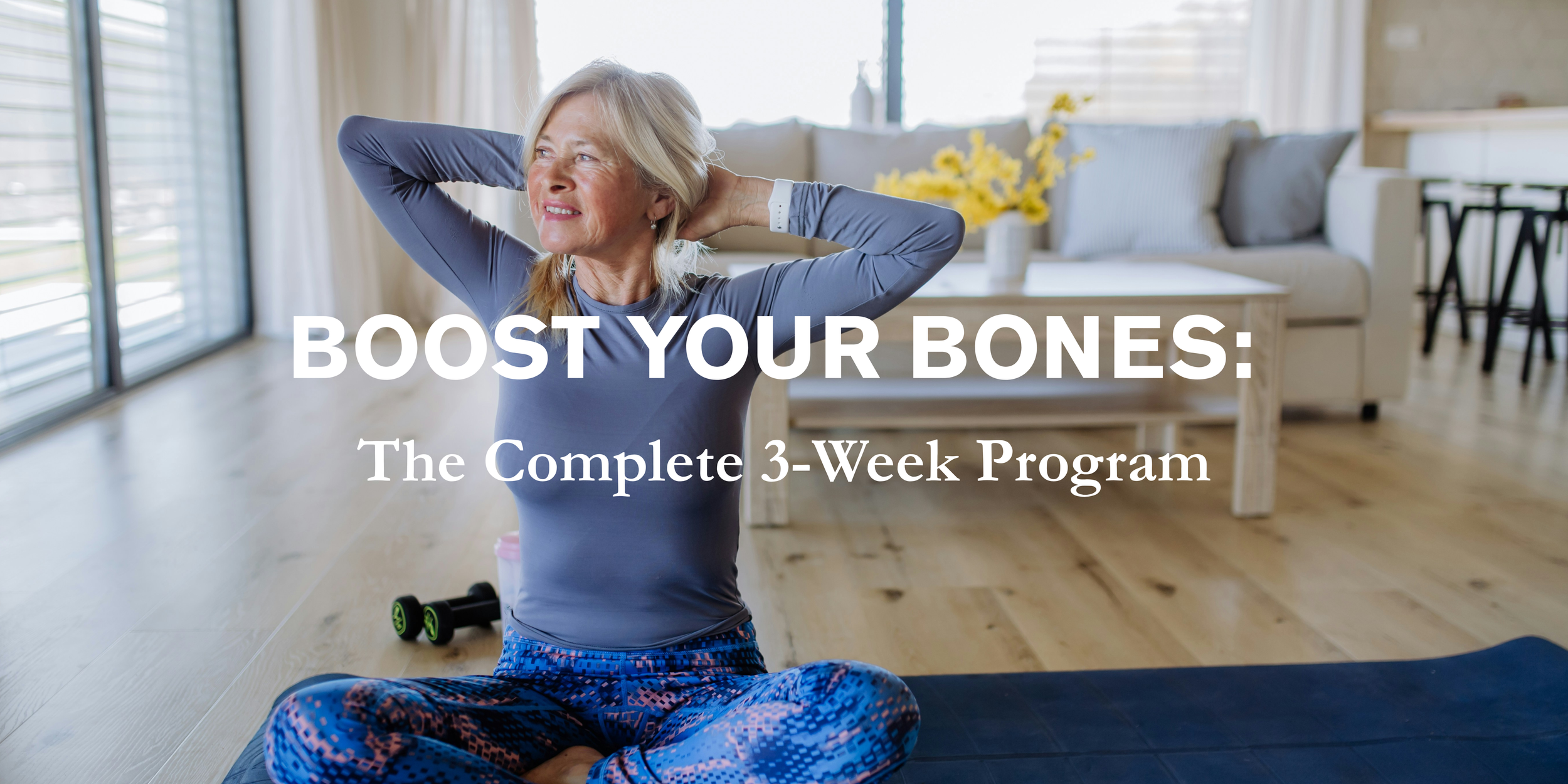
If you loved the 20-minute sample class above and want a complete, step-by-step roadmap designed specifically for midlife health, I invite you to join my Boost Your Bones Pilates Program.
This is a premium, structured 3-week Pilates program created for active women over 50 who want a concrete blueprint to stay strong, improve postural alignment, and build bone resilient patterns safely.
🗓️ A Structured 3-Week Progressive Sequence: Eliminate the guesswork of what moves are safe or effective for your spine and hips.
🧘 Spine, Hip, and Wrist Targeted: Specifically isolates and strengthens the key zones most vulnerable to bone density loss.
🏡 Gentle and Equipment-Minimal: Safe for home spaces using simple, light 3–5 lb hand weights.
Stop wondering what video to click next. Give yourself a professional, sustainable plan that fits beautifully into your real life.
About the Author
Christine Kirkland is a certified Pilates instructor and the founder of an online movement studio dedicated to helping women over 40 build sustainable strength, agility, and joint longevity. After stepping away from punishing, high-impact gym routines, Christine dedicated her career to teaching joint-friendly, functional movement that respects the changing needs of the midlife body. She is a regular wellness contributor to Sixty and Me. Want to protect your bone health? Explore her signature Boost Your Bones Program today.